Is a Lab Test Safe If It Doesn't Have FDA Approval?
Catalina Galeano-Garces, Ph.D.
Lab Manager
For many patients, seeing the words “not FDA approved” attached to a medical test can immediately raise concerns.
Is it safe? Is it accurate? Should you trust the results?
The answer may surprise you: many laboratory tests used every day in healthcare are not FDA-approved products. Instead, they are known as laboratory-developed tests (LDTs) and are regulated through a different oversight system designed specifically for clinical laboratories.
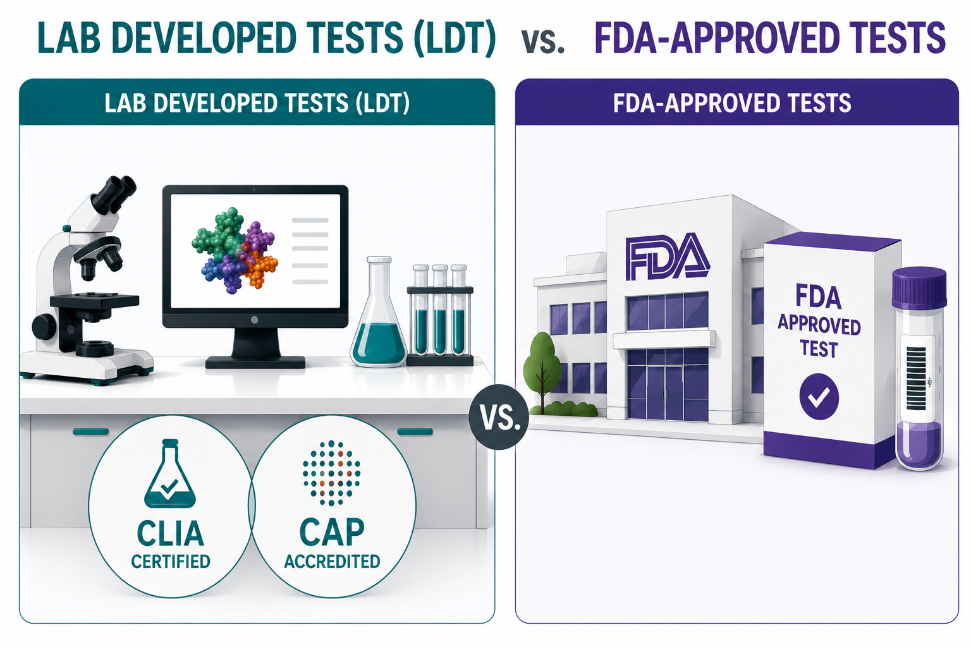
Understanding the difference can help you make informed decisions about your healthcare and evaluate whether a test is appropriate for your situation.
What Is a Lab-Developed Test (LDT)?
A laboratory-developed test is exactly what it sounds like: a diagnostic test that is designed, validated, and performed within a single certified laboratory.
Unlike commercial test kits that are manufactured and sold to multiple labs, LDTs are developed and used by highly specialized laboratories to address specific clinical needs.
Many advances in medicine have relied on LDTs because laboratories can often innovate more quickly than traditional product manufacturers. Today, thousands of LDTs are used across oncology, genetics, infectious disease testing, prenatal screening, and other areas of medicine.
According to the American Clinical Laboratory Association and the American Hospital Association (AHA), LDTs account for a substantial portion of advanced diagnostic testing performed in the United States and play a critical role in personalized medicine.1,2
If an LDT Isn't FDA Approved, Who Oversees It?
This is where many patients become confused.
FDA approval is one form of oversight, but it is not the only one.
Clinical laboratories performing LDTs are typically regulated under the Clinical Laboratory Improvement Amendments (CLIA) program and may also be accredited by the College of American Pathologists (CAP).3,4
These oversight programs focus on ensuring that laboratories:
-
Produce accurate and reliable results
-
Follow strict quality control procedures
-
Validate test performance
-
Maintain qualified personnel
-
Participate in ongoing proficiency testing
-
Meet rigorous inspection requirements
Think of it this way:
FDA approval evaluates a medical product.
CLIA certification and CAP accreditation evaluate the laboratory itself and its ability to consistently produce high-quality results.
Both systems are designed to protect patients, but they approach oversight differently.
What Is CLIA Certification?
CLIA is a federal regulatory program administered by the Centers for Medicare & Medicaid Services (CMS).
Any laboratory performing human diagnostic testing in the United States must meet CLIA standards.
CLIA requirements include:
-
Laboratory quality systems
-
Personnel qualifications
-
Equipment maintenance
-
Quality assurance programs
-
Validation of testing methods
-
Ongoing performance monitoring
A CLIA-certified laboratory must demonstrate that its testing processes consistently generate reliable results.
For patients, CLIA certification provides assurance that a laboratory meets nationally recognized standards for quality and accuracy.
What Is CAP Accreditation?
Many leading laboratories go a step further by obtaining accreditation from the College of American Pathologists (CAP).
CAP accreditation is widely considered one of the most rigorous laboratory quality programs in healthcare.
CAP inspections assess:
-
Laboratory operations
-
Quality management systems
-
Test validation procedures
-
Staff competency
-
Patient safety practices
-
Ongoing performance improvement
CAP inspectors are practicing laboratory experts who evaluate whether a laboratory is meeting the highest standards of clinical excellence.
A laboratory that is both CLIA-certified and CAP-accredited demonstrates a strong commitment to quality, reliability, and continuous improvement.
Common Medical Tests That Are LDTs
Many patients are surprised to learn how common LDTs are.
Examples include:
-
Certain genetic testing panels
-
BRCA hereditary cancer risk testing (historically offered as LDTs)
-
Specialized oncology biomarker tests
-
Molecular pathology tests
-
Some infectious disease diagnostics
-
Certain prenatal screening tests
-
Advanced cancer detection and monitoring tests
These tests are routinely used by physicians and healthcare systems across the country to help guide clinical decision-making.
The absence of FDA approval does not automatically mean a test lacks scientific validity or clinical utility.
What Should Patients Look For When Evaluating an LDT?
Rather than focusing solely on FDA status, consider several important questions.
1. Is the laboratory CLIA-certified?
This is a foundational requirement for high-complexity clinical testing.
2. Is the laboratory CAP-accredited?
CAP accreditation adds another important layer of independent quality oversight.
3. Has the test been clinically validated?
Look for published research, performance data, and evidence supporting how the test performs in real-world patient populations.
4. Is the test being used alongside physician guidance?
The best diagnostic tests support conversations between patients and healthcare providers - not replace them.
What This Means for Breast Cancer Screening and Detection
Blood-based testing is an emerging area of innovation designed to complement -not replace - standard screening and diagnostic pathways.
Certitude is a blood-based test designed to detect breast cancer proteins specifically for women with dense breast tissue, inconclusive imaging or have an elevated risk of breast cancer. It is a CLIA-certified, CAP-accredited laboratory-developed test after undergoing a comprehensive evaluation of Astrin’s St. Paul laboratory’s operations, including quality control procedures, staff qualifications, equipment, facilities, safety programs, and overall management. These inspections are designed to ensure laboratories meet the most current best practices and maintain the highest standards of care for patients.
The Bottom Line
A test does not need FDA approval to be safe, reliable, or clinically useful.
Many highly respected diagnostic tests are laboratory-developed tests performed in CLIA-certified and CAP-accredited laboratories.
When evaluating any medical test, focus on:
-
Laboratory quality standards
-
Clinical validation
-
Scientific evidence
-
Physician involvement
-
The clinical problem the test is designed to address
The goal is not simply finding a test with a particular regulatory label. The goal is finding trustworthy information that helps you and your healthcare team make confident decisions.
Less uncertainty. More confidence.
If you have dense breasts and want to understand your options, talk with your doctor about whether additional testing may be appropriate for you. You can also learn more about how Certitude fits into care and sign up to receive information about accessing the test.