Dense Breasts and Mammograms: What Women Should Know
Tanya Gupta, M.D.
Medical Director
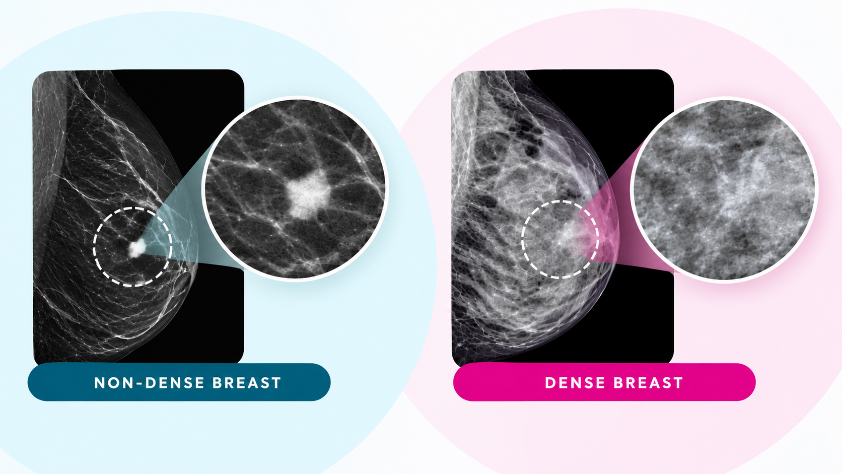
Getting your mammogram is an important step in taking care of your breast health. But if your results say you have dense breasts, there is something else worth knowing: breast density can make cancer more difficult to see on a mammogram.
Dense breasts are common. According to the National Cancer Institute, nearly half of women age 40 and older who have mammograms have dense breast tissue.1 Having dense breasts does not mean something is wrong. But it can affect both your breast cancer risk and how well a mammogram can detect cancer.
Understanding that difference can help you have a more informed conversation with your healthcare provider about your individual risk and whether additional screening may be appropriate.
What Does It Mean to Have Dense Breasts?
Breasts contain a combination of fatty tissue, connective tissue and glandular tissue. Breast density describes the relative amounts of these tissues as they appear on a mammogram—it is not something you can determine by how your breasts look or feel.1
BI-RADS A–D is part of the Breast Imaging Reporting and Data System (BI-RADS), a standard used by radiologists to describe breast tissue density on mammograms.2 Radiologists generally describe breast density using four categories:
BI-RADS A. Almost entirely fatty
The breast contains mostly fatty tissue.
BI-RADS B. Scattered areas of fibroglandular density
There are some areas of dense tissue, but much of the breast is fatty.
BI-RADS C. Heterogeneously dense
There is enough dense tissue that small abnormalities may be obscured.
BI-RADS D. Extremely dense
Most of the breast is made up of dense tissue, which can make abnormalities more difficult to identify.
Women in categories C and D are generally considered to have dense breasts.
Why Can Dense Breasts Make Mammograms Less Effective?
The challenge comes down to what different tissues look like on a mammogram.
Fatty breast tissue appears relatively dark, while dense fibrous and glandular tissue appears white. Many breast abnormalities can also appear white.1
That can create a masking effect—something like looking for a white object against a white background.
As breast density increases, detecting a cancer on mammography can therefore become more challenging. Mammography generally performs best in breasts that are predominantly fatty, while its sensitivity decreases as the amount of dense tissue increases. The National Cancer Institute notes that mammography is less sensitive in women with dense breasts and is therefore more likely to miss a cancer.1
In practical terms:
| Breast density | What it means for mammography |
|---|---|
| A — Almost entirely fatty | Least masking from dense tissue; abnormalities may be easier to distinguish |
| B — Scattered density | Some dense areas may make certain findings more difficult to see |
| C — Heterogeneously dense | Dense tissue can obscure small abnormalities and reduce mammography sensitivity |
| D — Extremely dense | Greatest potential for masking; mammography sensitivity is lower as density increases |
This does not mean mammograms are ineffective or unnecessary for women with dense breasts. Mammography remains a primary breast cancer screening tool. The FDA describes mammography as the most effective primary screening method for finding breast cancer in its earliest, most treatable stages.3
Dense Breasts Also Affect Breast Cancer Risk
Breast density matters for another reason: it is itself a breast cancer risk factor.
According to the National Cancer Institute, women with dense breasts have a higher risk of developing breast cancer than women with fatty breasts, independent of the difficulty density creates when interpreting mammograms.1
The degree of density matters as well. Susan G. Komen reports that women with extremely dense breasts may have four to five times the breast cancer risk of women whose breasts are almost entirely fatty.4
Breast density is only one part of your overall risk. Age, family history, genetic factors, previous breast findings and other health factors can also influence risk. That is why knowing your density can be a useful starting point for a broader conversation with your healthcare provider.
Why Finding Breast Cancer Early Matters
Early detection can make a meaningful difference.
Recent National Cancer Institute data show a strong relationship between the extent of breast cancer at diagnosis and five-year relative survival. For breast cancer confined to the breast, five-year relative survival is approximately 99% or higher. Survival is substantially lower once cancer has spread to regional lymph nodes or distant areas of the body.5
These statistics describe large groups of patients and cannot predict what will happen for any one person. Cancer biology, treatment, age, overall health and other factors also affect outcomes.5
But the larger message is clear: identifying breast cancer before it has spread can expand treatment options and early stage breast cancer diagnosis is associated with substantially better outcomes.
What Should You Do If You Have Dense Breasts?
Since September 2024, mammography facilities in the United States have been required by the FDA to tell patients whether their breasts are dense or not dense in their mammography results.6
If your report says you have dense breasts, it does not automatically mean you need another test. It does mean you have information that can help you and your healthcare provider make a more individualized decision.
Ask questions such as:
- What is my breast density category?
- How does my breast density affect my overall breast cancer risk?
- Are there other risk factors I should consider?
- Would supplemental screening be appropriate for me?
- What are the benefits and limitations of the available screening options?
Additional imaging, such as ultrasound or breast MRI, may be considered for some patients. However, there is not one supplemental screening approach that is right for every woman with dense breasts. Current USPSTF guidance states that evidence is insufficient to recommend for or against supplemental ultrasound or MRI solely because a woman has dense breasts after an otherwise negative mammogram.7 Decisions about additional screening should therefore be individualized with a healthcare professional.
Understanding Your Breast Density is One Part of Your Breast Health
Learning that you have dense breasts can raise questions, but it can also give you useful information about your health.
Continue recommended mammography screening. Know your breast density. Understand your individual risk. And talk with your healthcare provider about whether another layer of screening or information may be appropriate for you.
Being proactive does not mean assuming something is wrong. It means understanding your options and making informed decisions about what comes next.
Footnotes
-
Dense Breasts: Answers to Commonly Asked Questions - NCI ↩ ↩2 ↩3 ↩4 ↩5
-
What Your BI-RADS Score Means - National Breast Cancer Foundation ↩
-
Dense Breast Tissue & Breast Cancer Risk | Susan G. Komen® ↩
-
U.S. Preventive Services Task Force. Breast Cancer Screening: Frequently Asked Questions. Current guidance accessed 2026. ↩