Genomic vs. Proteomic Testing: Can a Blood Test Detect Breast Cancer Early?
Justin M. Drake, Ph.D.
Chief Science Officer
For many women, breast cancer screening begins with a mammogram. Mammograms remain the standard of care and save lives through early detection. But for women with dense breasts, screening can sometimes feel more complicated.
You may have heard about blood tests that claim to detect cancer. Are they real? How do they work? And can they help detect breast cancer earlier?
Here's what women should know.
Not All Cancer Blood Tests Look for the Same Thing
When people hear the phrase "blood test for cancer," they often assume all tests work the same way.
They don't.
Today's cancer blood tests generally fall into two categories:
-
Genomic tests, which analyze DNA or RNA
-
Proteomic tests, which analyze proteins circulating in the blood
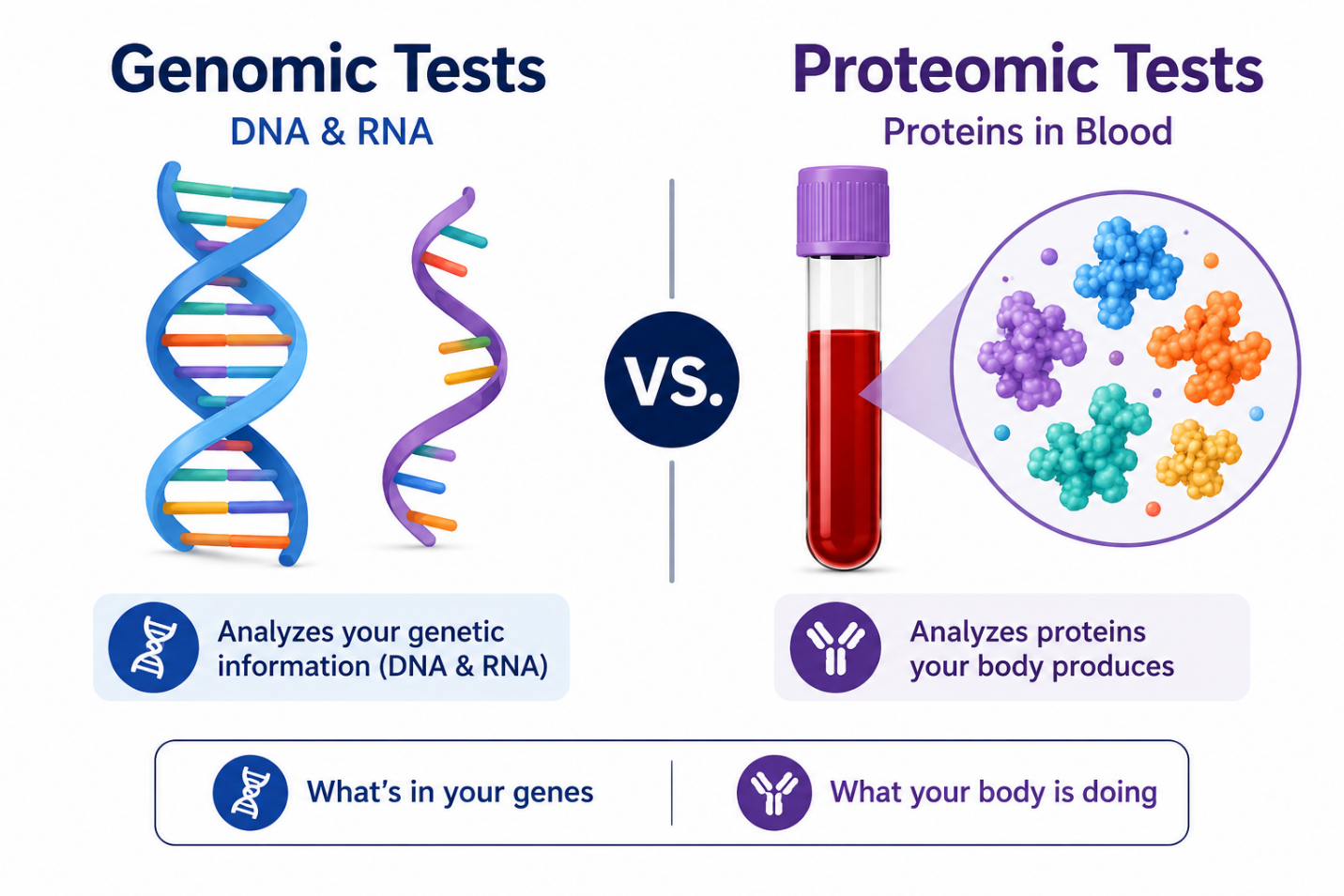
Understanding the difference is important because the biology behind a test can influence how well it works for specific cancers.
And when it comes to breast cancer, that distinction matters.
Genomic Testing: Looking for Cancer's Genetic Signals
Genomic testing examines genetic material that may be associated with cancer.
Many people are familiar with consumer DNA tests such as 23andMe® or AncestryDNA®. Those tests look at inherited genetic traits and ancestry.
Cancer detection tests are different.
Instead of looking at the DNA you were born with, many cancer blood tests search for genetic material that may be shed by tumors into the bloodstream.
There are two concepts that often get confused:
Germline Genetics: The DNA You Inherit
Germline testing looks for inherited mutations passed down through families.
Examples include BRCA1 and BRCA2 mutations, which can increase breast cancer risk.
These tests help identify risk, but they do not determine whether cancer is currently present.
Tumor-Derived Genetic Signals: The DNA Cancer Releases
Some blood-based cancer tests search for tumor-derived DNA or RNA circulating in the bloodstream.
This approach is often called a "liquid biopsy."
The goal is to identify cancer-related genetic signals without needing a tissue sample.
DNA vs. RNA: What's the Difference?
Many genomic cancer tests analyze either DNA or RNA.
DNA-Based Testing
DNA-based tests look for fragments of genetic material released by tumors.
Potential advantages include:
-
Highly specific molecular information
-
Ability to identify mutations associated with cancer
-
Broad applicability across multiple cancer types
Challenges include:
-
Some cancers release very little DNA into the bloodstream during early stages
-
Detection can become easier as tumors grow larger
RNA-Based Testing
RNA reflects genes that are actively being expressed.
Potential advantages include:
-
May provide insight into active biological processes
-
Can reveal molecular changes not captured by DNA alone
Challenges include:
-
RNA is less stable than DNA
-
Signal detection can be technically complex
Many emerging cancer blood tests use combinations of DNA, RNA, and artificial intelligence to improve performance.
The Challenge: Does Genomic Testing Work Well for Detecting Breast Cancer?
Genomic technologies have generated significant excitement, particularly in the multi-cancer early detection (MCED) field.
However, breast cancer presents a unique challenge.
Many cancers that perform well in DNA-based blood testing shed substantial amounts of tumor DNA into the bloodstream.
Breast cancer often does not.
In early-stage breast cancer—when detection matters most—there may be very little circulating tumor DNA available to detect.
Researchers have repeatedly noted that breast cancer is among the more difficult cancers for DNA-based blood tests to identify at the earliest stages because of limited tumor shedding.1
This doesn't mean genomic testing has no role in breast cancer care. Genomic technologies are widely used in treatment selection, recurrence monitoring, and inherited risk assessment.
But detecting early breast cancer through blood alone may require looking beyond DNA.
Proteomic Testing: Looking at Proteins Instead of Genes
Rather than searching for genetic material, proteomic testing analyzes proteins circulating in the blood.
Proteins are the molecules that carry out many biological functions in the body.
When cancer develops, protein patterns can change long before symptoms or tumors appear.
Scientists can measure these changes and use them as biological signals that may indicate disease.
Think of it this way:
-
DNA represents the blueprint.
-
Proteins represent what the body is actively doing.
For certain cancers, including breast cancer, protein changes may provide important information even when tumor DNA is difficult to detect.
Why Proteomics May Be Well-Suited for Breast Cancer
Because breast tumors may shed limited amounts of DNA during early stages, researchers have increasingly explored protein-based approaches.
Proteins can reflect biological changes associated with cancer even when circulating tumor DNA remains low.
This has led to the development of blood tests specifically designed around breast cancer biology rather than applying a one-size-fits-all approach across many cancer types.
Certitude's Proteomic Approach
Instead of relying primarily on DNA shedding, Certitude™ was designed specifically to analyze proteins associated with breast cancer.
This approach is intended to provide a deeper layer of insight that can help support conversations between women and their healthcare providers when breast cancer detection may be more challenging.
According to Certitude validation data2:
-
90% sensitivity for breast cancer detection
-
Greater than 99% negative predictive value in women with dense breasts
No blood test replaces mammography. However, understanding the biology behind different testing approaches can help women make more informed decisions.
Less Uncertainty. More Confidence.
The future of cancer detection is unlikely to rely on a single technology.
The most effective approaches will be those designed around the biology of specific cancers.
For breast cancer, that may mean looking beyond DNA and exploring the value of proteins as another source of insight.