What Is Supplemental Breast Cancer Screening? Understanding Your Options Beyond a Mammogram
Badrinath Konety, M.D.
Chief Medical Officer
Learn more about the different types of breast cancer screening, what supplemental screening means for women with dense breasts, and how options like Certitude may provide another layer of insight to help inform next steps.
You scheduled your mammogram, showed up for the appointment, and took an important step for your health. Then your results arrived with information you may not have expected: You have dense breasts.
What does that mean? And should you be doing something more?
For many women, understanding the difference between routine screening, supplemental screening, and diagnostic testing can make the next conversation with a healthcare provider much clearer.
First: What Is Breast Cancer Screening?
Breast cancer screening means looking for cancer before you have signs or symptoms. Mammography remains the primary breast cancer screening tool for most women. The CDC notes that mammograms can find cancers before they are large enough to feel or cause symptoms, and regular mammography can reduce the risk of dying from breast cancer.1
Current U.S. guidance varies somewhat by organization and individual risk, but mammography remains the foundation of breast cancer screening.
A mammogram also provides another important piece of information: your breast density.
Approximately half of women over age 40 in the United States have dense breast tissue.2 Dense tissue matters for two reasons: it can make breast cancer more difficult to see on a mammogram, and having dense breasts is itself associated with increased breast cancer risk.2
Since September 2024, mammography facilities across the United States have been required to tell patients whether their breasts are dense or not dense.2
Knowing your density can help you and your healthcare provider have a more informed conversation about whether additional screening may be appropriate.
What Is Supplemental Breast Cancer Screening?
Supplemental screening is additional testing performed alongside, not instead of, routine mammography.
Think of it as another way of looking for information that may be harder to see with mammography alone.
Depending on a woman's breast density, overall breast cancer risk, medical history, and other factors, supplemental options may include:
-
Breast MRI, which uses a strong magnet and radio waves to create detailed breast images.
-
Breast ultrasound, which uses sound waves to examine breast tissue.
-
Blood tests, which look for breast cancer signals in the blood.
-
Other imaging technologies, which may be available or appropriate in certain clinical settings.
MRI is more sensitive for detecting breast cancer than mammography and is commonly used with mammography for women at high risk. However, supplemental tests can also identify findings that ultimately turn out not to be cancer, leading to additional imaging or biopsies.3
For women whose primary risk factor is dense breast tissue, the evidence continues to evolve. The National Cancer Institute notes that there is not yet enough evidence to recommend for or against supplemental ultrasound or MRI for all women with dense breasts.4
That makes an individualized conversation with your healthcare provider especially important.
Screening vs. Diagnostic Testing: What's the Difference?
These terms are easy to confuse, but they serve different purposes.
Screening tests
Screening tests are used when you do not have breast cancer symptoms. Their goal is to find cancer as early as possible.
Supplemental screening
Supplemental screening adds another test to routine screening when additional information may be useful, such as for some women with dense breasts or increased breast cancer risk where the routine screening test has a high likelihood of missing a cancer.
Diagnostic testing
Diagnostic testing is different. It is used to investigate a specific concern for example, a lump, another breast symptom, or an abnormal finding on a screening mammogram.
After an abnormal screening mammogram, diagnostic evaluation may include a more detailed diagnostic mammogram, ultrasound, MRI, and, when necessary, a biopsy.5 An abnormal screening result does not automatically mean you have breast cancer; it means more testing is needed.
Why Dense Breasts Can Change the Conversation
Dense breast tissue and some cancers can appear similar on a mammogram, making abnormalities more difficult to distinguish. The FDA specifically notes that extremely dense breasts lower mammography's sensitivity.2
That does not mean mammography is unimportant if you have dense breasts. Women with dense breasts still need routine mammography. Instead, breast density is one factor that may help determine whether another layer of screening makes sense for you.
There is also no single supplemental test that is automatically right for every woman with dense breasts. Your provider may consider factors including:
-
Your breast density category
-
Your age
-
Family and personal medical history
-
Genetic or other known risk factors
-
Previous breast findings
-
The benefits and limitations of available tests
-
Access, cost, and insurance coverage
-
Your preferences
The goal is not simply to do more testing. It is to determine which information is meaningful for your care.
Where Could a Blood-Based Test Fit?
For women with dense breasts, emerging blood-based approaches may offer another way to support care decisions without adding another imaging procedure.
Certitude® is a non-invasive, blood-based option designed to support breast cancer detection and help inform next steps for women with dense breasts. It is designed to work alongside mammography or medically indicated diagnostic testing.
Certitude has demonstrated 93% sensitivity and a negative predictive value (NPV) greater than 99% in women with dense breasts. In simple terms, sensitivity describes how often a test correctly identifies cancer when cancer is present. NPV describes the likelihood that a person with a negative result truly does not have cancer.
For a patient wondering what to do after learning she has dense breasts, that additional information may help support a more informed conversation with her healthcare provider about follow-up care.
What Might Your Breast-Screening Path Look Like?
Although every patient's care is individual, a typical pathway may look something like this:
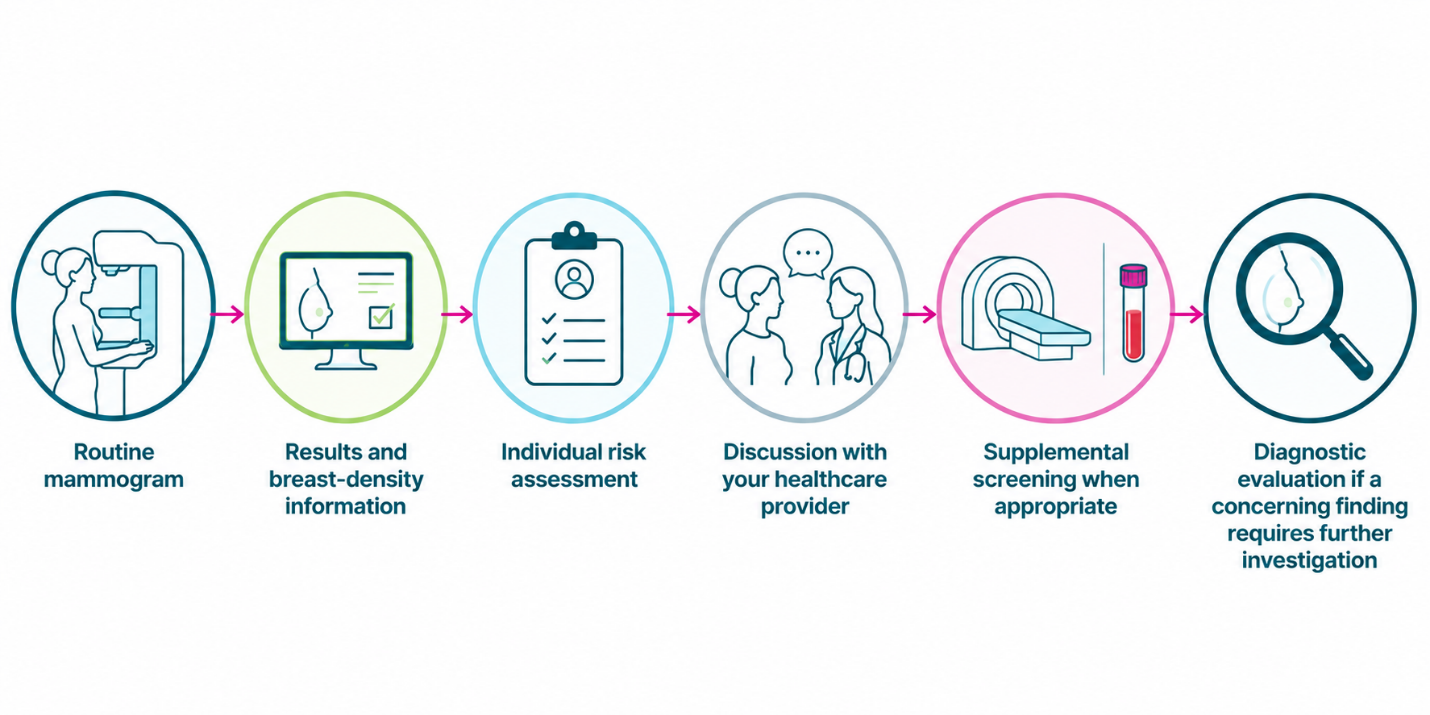
A biopsy may ultimately be needed to determine whether a suspicious finding is cancer.5 Supplemental screening does not replace that diagnostic process.
The important point is that receiving a dense-breast notification is information you can act on thoughtfully, rather than a reason to assume something is wrong.
Questions to Ask at Your Next Appointment
If your mammogram says you have dense breasts, consider asking:
-
What is my breast-density category?
-
What is my overall breast cancer risk?
-
How does my breast density affect the ability of mammography to detect cancer?
-
Would supplemental screening be appropriate for me?
-
What are the benefits and limitations of MRI, ultrasound, or other options?
-
Could a blood-based test such as Certitude provide useful additional information in my situation?
-
What would happen next based on each possible test result?
Breast screening is not always a one-size-fits-all process - particularly for women with dense breasts.
Being proactive does not have to mean pursuing every test available. It means understanding your options and making an informed decision with your healthcare provider.
Learn more about Certitude and talk with your healthcare provider about whether it may be appropriate for you.