What to Do After Receiving a Dense Breast Notification
Badrinath Konety, M.D.
Chief Medical Officer
Opening your mammogram results and seeing the words "You have dense breasts" can be confusing especially if you've never heard the term before. You may wonder what it means, whether you should be concerned, and what you should do next.
The good news is that a dense breast notification is meant to inform, not alarm. Understanding what it means can help you take a more proactive role in your breast health and have informed conversations with your healthcare provider.
What Is a Dense Breast Notification?
A dense breast notification is a message included with your mammogram results that tells you whether your breast tissue is considered "dense."
Beginning in September 2024, the U.S. Food and Drug Administration (FDA) required all mammography facilities in the United States to notify patients about their breast density using standardized language.1
The goal is simple: ensure every woman receives consistent information about breast density and understands that it may influence breast cancer screening.
What Happened Before the FDA Requirement?
Before the federal rule took effect, breast density notification laws varied by state. Some states required patients to be informed, while others did not. The wording also differed significantly, making it difficult for women to know what their results meant or whether they should discuss additional screening with their healthcare provider.
The FDA's national standard helps ensure women receive the same essential information regardless of where they receive their mammogram.
What Does "Dense Breasts" Mean?
Breast density refers to the amount of fibrous and glandular tissue compared with fatty tissue visible on a mammogram. According to the Mayo Clinic, breast density cannot be determined by how your breasts look or feel, it can only be evaluated through mammography.2
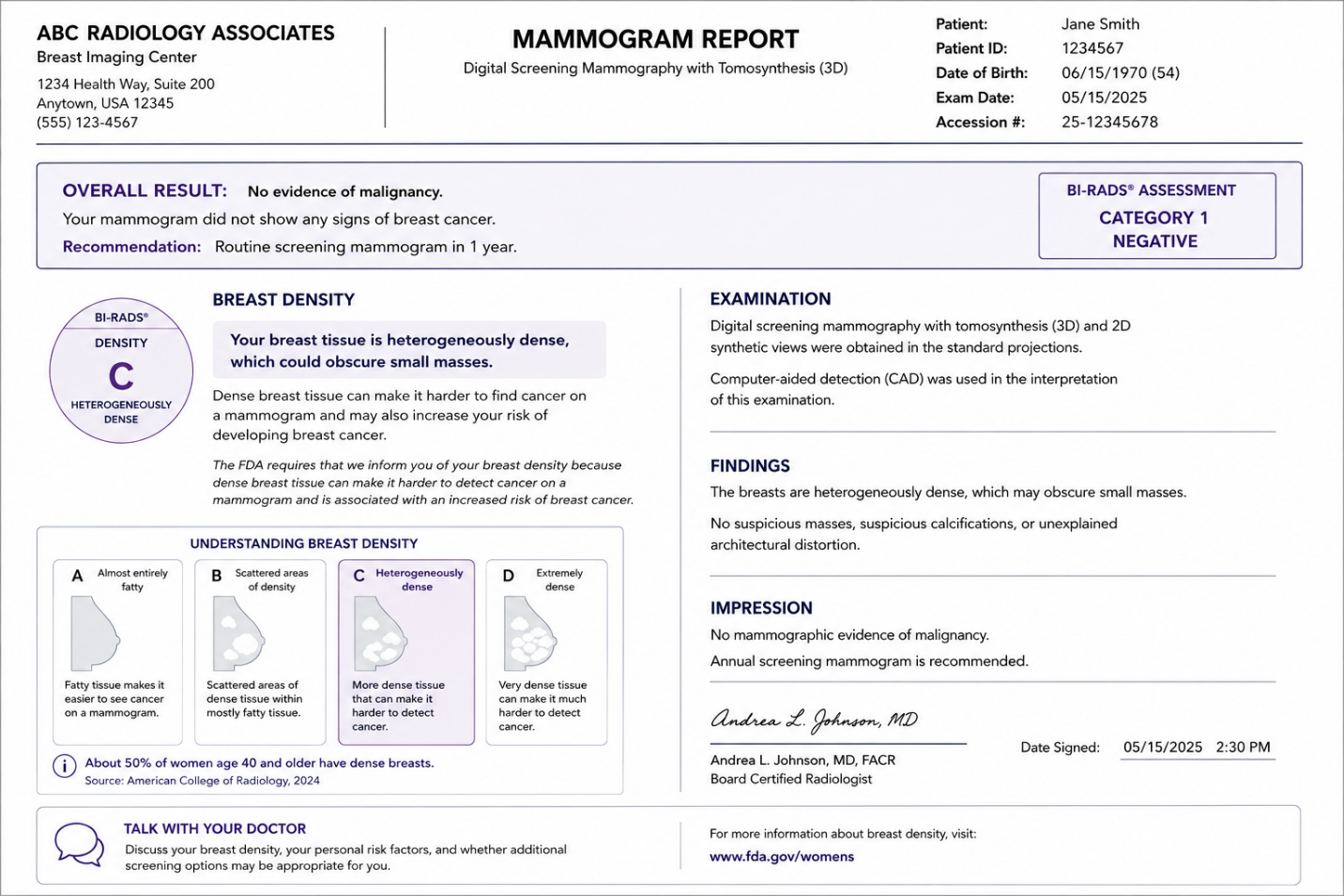
Radiologists classify breast density into four BI-RADS categories:
-
BI-RADS A: Almost entirely fatty
-
BI-RADS B: Scattered areas of fibroglandular density
-
BI-RADS C: Heterogeneously dense
-
BI-RADS D: Extremely dense
Women in the last two categories are considered to have dense breasts. According to the U.S. Centers for Disease Control and Prevention, approximately 50% of women age 40 and older have dense breast tissue.3
Why Does Breast Density Matter?
Dense breast tissue matters for two important reasons.
First, dense tissue can make breast cancers more difficult to detect on a mammogram because both dense tissue and many cancers appear white on the image, an effect sometimes referred to as the masking effect.
Second, breast density is considered an independent risk factor for breast cancer. While density alone does not determine your risk, it is one factor noted by the American Cancer Society that providers consider alongside age, family history, genetics, and other personal risk factors.4
What Might Your Breast Density Notification Say?
The FDA requires mammography facilities to include standardized information about breast density in the results patients receive. While the wording may vary slightly, your notification will indicate one of four breast density categories and explain what it means for your breast health and screening.1
Almost Entirely Fatty
"Your breasts are almost entirely fatty. Fatty breast tissue makes it easier for radiologists to detect abnormalities on a mammogram. Continue routine breast cancer screening as recommended by your healthcare provider."
What this means: Fatty breast tissue provides greater contrast on a mammogram, making it easier to identify potential abnormalities. This is the lowest breast density category and does not require any special follow-up based on breast density alone.
Scattered Areas of Fibroglandular Density
"Your breasts have scattered areas of fibroglandular density. This means there are some dense areas within predominantly fatty breast tissue. Continue routine breast cancer screening as recommended and discuss any personal risk factors with your healthcare provider."
What this means: This is a common breast density category. Most of the breast tissue is fatty, with some scattered areas of dense tissue. Mammograms generally remain highly effective, although your healthcare provider will continue to consider your overall risk profile when recommending screening.
Heterogeneously Dense
"Your breasts are heterogeneously dense, which means there are some areas of dense tissue. Dense tissue can make it harder to find breast cancer on a mammogram and may also increase your risk of developing breast cancer. Talk with your healthcare provider about your breast density, your personal risk factors, and whether additional screening may be appropriate."
What this means: Dense tissue can make some cancers more difficult to see on a mammogram. Your healthcare provider may discuss whether your personal risk factors warrant additional evaluation or supplemental screening.
Extremely Dense
"Your breasts are extremely dense. Dense breast tissue lowers the sensitivity of mammography and is associated with an increased risk of breast cancer. Discuss your screening plan with your healthcare provider to determine the approach that is right for you." (Adapted from FDA-required notification language)
What this means: Extremely dense breast tissue can make mammograms more challenging to interpret. Your healthcare provider may recommend a personalized discussion about your breast cancer risk and whether additional screening options or other evidence-based tools may be appropriate.
Understanding Your Breast Density Results
| Breast Density Category | How Common Is It? | What It Means for Screening |
|---|---|---|
| Almost Entirely Fatty | Less common | Mammograms generally provide the clearest images. |
| Scattered Fibroglandular Density | Common | Mammograms remain highly effective. |
| Heterogeneously Dense | Common | Dense tissue may make some cancers harder to detect. |
| Extremely Dense | Less common | Dense tissue can significantly reduce mammogram sensitivity and may warrant a discussion about additional screening based on your overall risk. |
What Should You Do Next?
For many women, the next step is simply having a conversation with their healthcare provider.
NCCN guidelines recommend that breast cancer screening decisions consider a woman's overall risk profile rather than breast density alone.5
Questions you may want to ask include:
-
What is my breast density category?
-
How does breast density affect my personal breast cancer risk?
-
Is routine mammography sufficient for me?
-
Should I consider supplemental screening based on my risk factors?
-
Are there additional tools that may help provide more information?
Your answers will depend on your individual health history and risk assessment.
Understanding Your Screening Options
Mammography remains the cornerstone of breast cancer screening and continues to save lives.3 For some women with dense breasts, however, additional evaluation may be appropriate depending on their overall risk.
Your healthcare provider may discuss options such as:
-
Continuing routine mammograms
-
Breast ultrasound
-
Breast MRI
-
Blood-based tests
-
Other evidence-based approaches that may help provide additional information when imaging leaves unanswered questions
Every woman's situation is different, and your care plan should reflect your unique needs.
Another Layer of Insight
If you have dense breasts and your screening results leave questions, there may be another step.
Certitude™ is an advanced blood-based test designed to provide another layer of insight and support conversations between patients and their healthcare providers. It is intended to complement not replace standard mammograms.
Designed to integrate into existing care pathways, Certitude helps support informed decisions when imaging alone may not tell the whole story. It's one more way to move forward with greater clarity and confidence.
Take the Next Step
Receiving a dense breast notification is not the end of your screening journey, it's the beginning of a more informed conversation.
Understanding your breast density empowers you to ask questions, learn about your options, and work with your healthcare provider to determine the screening plan that's right for you.
Have you received a dense breast notification? Talk with your healthcare provider about what it means for your personal screening plan. If you have dense breasts and want to learn whether a blood-based test may be appropriate for you, learn more about the Certitude Blood Test and discuss it with your care team.