Understanding Your Options for Breast Cancer Screening and Early Detection
Badrinath Konety, M.D.
Chief Medical Officer
Breast cancer remains the most commonly diagnosed cancer among women in the United States outside of skin cancer. The American Cancer Society estimates that more than 310,000 women will be diagnosed with invasive breast cancer this year alone.1 At the same time, there is encouraging news: breast cancer mortality has declined by approximately 44% since 1989, largely due to advances in screening and treatment.
Early detection continues to be one of the most powerful tools available for improving outcomes. Yet many women are surprised to learn that breast cancer screening is not one-size-fits-all.
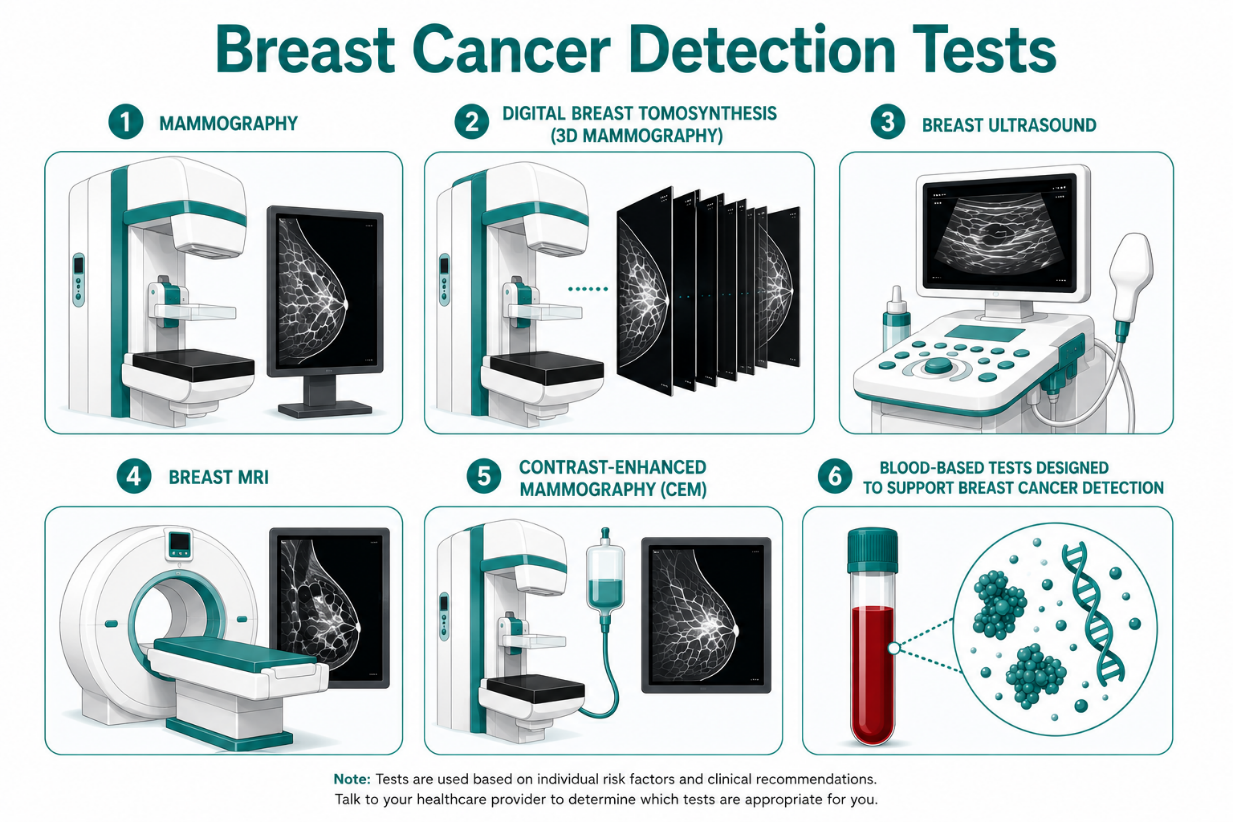
Today, women may have access to multiple screening and detection options, including:
-
Mammography
-
Digital Breast Tomosynthesis (3D Mammography)
-
Breast Ultrasound
-
Breast MRI
-
Contrast-Enhanced Mammography (CEM)
-
Blood-based tests designed to support breast cancer detection
Understanding the benefits, limitations, and appropriate use of each option can help women—particularly those with dense breasts—make more informed decisions with their healthcare providers. Learn more about why breast density matters here.
Mammography: The Foundation of Breast Cancer Screening
Mammography remains the standard screening tool recommended by major organizations including the American Cancer Society (ACS), American College of Radiology (ACR), and United States Preventive Services Task Force (USPSTF).
The USPSTF now recommends that average-risk women begin screening at age 40 and continue every other year through age 74.2
Benefits of Mammography
✔ Proven reduction in breast cancer mortality
✔ Widely available
✔ Covered by most insurance plans
✔ Detects many cancers before symptoms develop
✔ Established as the cornerstone of screening programs worldwide
Limitations
✔ Reduced sensitivity in dense breasts
✔ False-positive findings can occur
✔ Additional imaging may be required after abnormal results
Even with its limitations, mammography continues to detect the majority of breast cancers and remains the starting point for most screening plans.
Digital Breast Tomosynthesis (DBT): 3D Mammography
Digital Breast Tomosynthesis (DBT), commonly known as 3D mammography, has become increasingly common across the United States.
Unlike conventional mammography, DBT captures multiple images of the breast from different angles, creating a more detailed three-dimensional view.
Benefits
✔ Improved cancer detection rates compared with 2D mammography
✔ Reduced callback rates (how often a patient receives a call for further evaluation after a routine mammogram)
✔ Better visualization of overlapping breast tissue
✔ Particularly helpful for women with heterogeneously dense breasts
Research reviewed by the American College of Radiology has demonstrated that DBT improves cancer detection while reducing unnecessary recalls for additional testing.3
Limitations
✔ Dense tissue can still obscure cancers
✔ Additional imaging may still be necessary
✔ Availability varies by facility
For many women, DBT represents an important advancement over traditional mammography.
Breast Ultrasound
Breast ultrasound uses sound waves rather than radiation to create images of breast tissue.
It is commonly used as a supplemental screening tool for women with dense breasts or to evaluate abnormalities found on mammography.
Benefits
✔ No radiation exposure
✔ Can detect some cancers not visible on mammography
✔ Widely available
✔ Comfortable and non-invasive
Limitations
✔ Higher false-positive rates
✔ More follow-up imaging and biopsies
✔ Results may vary depending on operator’s experience
Studies have shown that supplemental ultrasound can identify additional cancers in women with dense breasts. However, it can also increase the number of findings that ultimately prove benign.4
This tradeoff is important for women to discuss with their healthcare providers.
Breast MRI
Among imaging modalities, breast MRI is generally considered the most sensitive screening tool available.
MRI uses magnetic fields and contrast enhancement to produce highly detailed images of breast tissue.
The American College of Radiology recommends MRI screening for many women at elevated risk, including certain women with genetic predispositions or strong family histories.5
Benefits
✔ Highest imaging sensitivity
✔ Detects cancers that may not be visible on mammography or ultrasound
✔ Particularly valuable for high-risk women
✔ Excellent performance in dense breast tissue
Limitations
✔ More expensive than mammography
✔ Requires intravenous contrast (dye is injected into a vein (intravenously) during the scan to enhance the visibility of certain structures and abnormalities)
✔ Longer exam times
✔ Higher false-positive rates
✔ Not appropriate for every patient
MRI can be an important part of a personalized screening strategy, especially for women with increased risk.
Contrast-Enhanced Mammography (CEM)
Contrast-Enhanced Mammography (CEM) is an emerging technology that combines mammography with intravenous contrast.
Cancer cells often develop abnormal blood vessel growth. The contrast agent helps highlight these areas, potentially improving visibility.
Benefits
✔ Enhanced lesion detection
✔ Greater sensitivity than conventional mammography
✔ May serve as an alternative when MRI is not available or appropriate
✔ Growing body of supporting evidence
Limitations
✔ Requires IV contrast
✔ Not available everywhere
✔ Additional radiation compared with standard mammography
✔ Insurance coverage may vary
The ACR recognizes CEM as an increasingly important supplemental imaging option for selected patients, particularly women with dense breasts.6
Certitude™: A Blood-Based Option Designed for Women with Dense Breasts
While traditional screening relies on imaging, advances in molecular science are creating new opportunities to support breast cancer detection.
Certitude is an advanced blood-based test designed specifically for detecting breast cancer in women with dense breasts, women who have inconclusive mammogram results, or have a family history or elevated risk of breast cancer.
Rather than producing images, Certitude analyzes biological signals found in a blood sample and provides another layer of information that may support clinical decision-making.
Approximately half of screening-age women have dense breasts, creating a substantial unmet need for additional tools that can complement existing screening pathways.
Benefits
✔ Simple blood draw
✔ Designed specifically for women with dense breasts, have inconclusive mammogram results, or have a family history or elevated risk of breast cancer
✔ Works alongside standard screening approaches
✔ Can be completed in a physician office, partner laboratory, or through approved collection services
Clinical Performance
According to Certitude validation data7:
-
Approximately 90% sensitivity
-
Greater than 99% negative predictive value (NPV) in women with dense breasts
A negative predictive value above 99% means that when a woman receives a negative result, there is greater than a 99% likelihood that breast cancer is not present.
Important Considerations
✔ Does not replace mammography
✔ Designed to support—not replace—physician-guided care
✔ Intended to provide another layer of insight when imaging leaves questions
As breast cancer screening continues to evolve, blood-based technologies may offer women and providers additional information to support confident decision-making.
Breast Cancer Screening Options at a Glance
| Screening Option | Primary Benefit | Potential Limitations |
|---|---|---|
| Mammography | Proven mortality reduction and standard of care | Reduced sensitivity in dense breasts |
| 3D Mammography (DBT) | Improved detection and fewer callbacks | Dense tissue can still obscure findings |
| Ultrasound | Detects additional cancers in dense breasts | Higher false-positive rates |
| MRI | Highest imaging sensitivity | Cost, contrast use, availability |
| CEM | Enhanced lesion visibility | Requires IV contrast, accessibility |
| Certitude | Blood-based option designed for dense breasts; >99% NPV | Not intended to replace imaging |
The Future of Breast Cancer Screening Is Personalized
Today's women have more screening options than ever before.
Mammography remains the foundation of breast cancer screening, but additional technologies—including DBT, ultrasound, MRI, CEM, and blood-based testing—can provide valuable information in specific clinical situations.
For women with dense breasts, understanding these options can help reduce uncertainty and support more informed conversations with healthcare providers.
If you have dense breasts, consider asking:
-
Is mammography alone appropriate for me?
-
Would supplemental screening improve detection?
-
What are the benefits and risks of MRI, ultrasound, or CEM?
-
Is a blood-based option like Certitude appropriate for my situation?
-
What screening plan best matches my personal risk factors?
The goal is not simply more testing. The goal is the right information at the right time to support confident decisions.
Talk with your doctor about your breast density, your personal risk factors, and the screening options that may be appropriate for you. If you have dense breasts and want another layer of insight, learn whether Certitude may be a fit for your breast health journey.
Footnotes
-
Breast Cancer Statistics | How Common Is Breast Cancer? | American Cancer Society ↩
-
Recommendation: Breast Cancer: Screening | United States Preventive Services Taskforce ↩
-
Screening Ultrasound as an Adjunct to Mammography in Women with Mammographically Dense Breasts - PMC ↩
-
Breast Cancer Screening for Women at Higher-Than-Average Risk: Updated Recommendations From the ACR - Journal of the American College of Radiology ↩
-
ACR Appropriateness Criteria® Supplemental Breast Cancer Screening Based on Breast Density: 2024 Update - Journal of the American College of Radiology ↩
-
Development and Validation of a Machine-Learning Deep Plasma Proteome Classifier for Early-Stage Breast Cancer Detection | Dovepress ↩