MCED vs. SCED: Can a Blood Test Detect Breast Cancer Early?
Justin M. Drake, Ph.D.
Chief Science Officer
For many women, breast cancer screening begins with a mammogram. Mammograms remain the standard of care and save lives through early detection. But for women with dense breasts, screening can sometimes feel more complicated.
You may have heard about blood tests that claim to detect cancer. Are they real? How do they work? And can they help detect breast cancer earlier?
Here's what women should know.
The Promise of Blood-Based Cancer Detection
Cancer blood tests are generating excitement across healthcare.
The idea is compelling: a simple blood draw that can help identify cancer before symptoms appear.
But not all cancer blood tests are designed the same way.
Two categories are emerging:
-
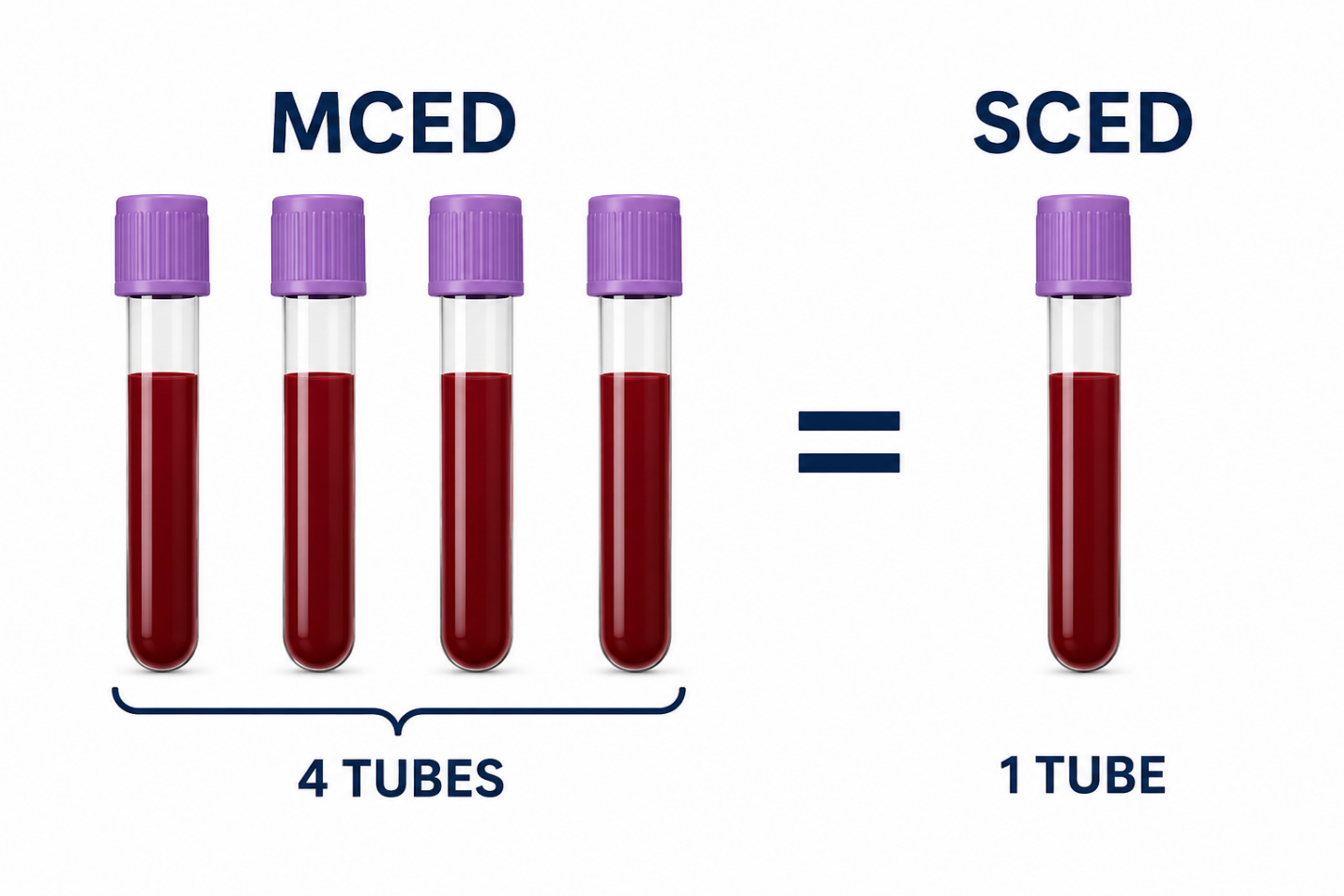
Multi-Cancer Early Detection (MCED) tests
-
Single-Cancer Early Detection (SCED) tests
Understanding the difference can help patients better evaluate what these tests can and cannot do.
What Are MCED Tests?
MCED stands for Multi-Cancer Early Detection.
These tests are designed to identify signals from many different cancers using a single blood sample.
Most MCED technologies like the Grail Galleri® or the Exact Sciences CancerGuard® tests analyze fragments of DNA or RNA circulating in the bloodstream.
The goal is ambitious: detect dozens of cancers simultaneously.
Researchers and healthcare leaders see enormous potential in this approach because many cancers currently have no routine screening options.
However, broad detection creates challenges.
The Challenge with MCEDs
Detecting many cancers with one test means balancing sensitivity (the ability of a test to correctly identify those with the condition), specificity (the ability of a test to correctly identify those without the condition), and clinical usefulness across very different tumor types.
Not all cancers behave the same way biologically.
Some cancers release large amounts of detectable DNA into the bloodstream.
Others release very little.
Breast cancer has been one of the more difficult cancers for many DNA-based MCED platforms to detect consistently at early stages.
This challenge has been highlighted by researchers evaluating large MCED studies and discussed extensively in recent conversations around the future of breast cancer detection. 1,2
The question isn't whether MCEDs have potential.
The question is whether a single biological approach can work equally well for every cancer.
Increasingly, many experts believe the answer may be no.
What Are SCED Tests?
SCED stands for Single-Cancer Early Detection.
Instead of trying to detect dozens of cancers simultaneously, SCEDs focus on one specific cancer.
This allows researchers to design tests around the unique biology of that cancer.
The strategy is similar to how traditional screening works today.
We don't use one test for breast cancer, colon cancer, and cervical cancer.
We use different tools because different cancers behave differently.
The same principle may apply to blood-based detection.
Why SCEDs May Drive Earlier Progress
MCEDs remain an exciting area of innovation.
But many of the most clinically successful blood-based screening tests today are focused on individual cancers. For example, the Guardant Shield™ blood test was developed specifically for colorectal cancer.
It has received significant clinical recognition because they were designed around the biology of one disease rather than many.
This focused approach can make it easier to optimize performance and demonstrate clinical utility.
Why Breast Cancer May Require a Different Strategy
As discussed in the article on genomic and proteomic testing, breast cancer often sheds relatively small amounts of tumor DNA during early stages.
That means many DNA-focused detection approaches may face biological limitations.
Rather than forcing breast cancer into a broader multi-cancer framework, some researchers are pursuing approaches designed specifically around breast cancer biology.
This is where SCEDs become particularly important.
Certitude™: A Breast Cancer-Specific Approach
Certitude is a Single-Cancer Early Detection (SCED) blood test developed specifically for detecting breast cancer in women with dense breasts, women who have inconclusive mammogram results, or have a family history or elevated risk of breast cancer.
Rather than searching broadly across many cancers, Certitude focuses on biological signals associated with breast cancer.
The test uses a proteomic approach, analyzing proteins rather than relying primarily on tumor DNA shedding.
This targeted design reflects a growing understanding that meaningful progress in cancer detection may require solutions tailored to individual cancers rather than a one-size-fits-all strategy.
According to Certitude validation data3:
-
90% sensitivity for detecting breast cancer
-
Greater than 99% negative predictive value in women with dense breasts
The Future of Blood-Based Detection
MCEDs represent an exciting frontier with the potential to transform cancer screening.
At the same time, SCEDs demonstrate the value of designing tests around the unique biology of individual cancers.
For breast cancer, especially in women with dense breasts, that distinction may be particularly important.
Because when it comes to early detection, understanding the biology is often the first step toward better answers.
Talk with your healthcare provider about your breast cancer screening options and whether additional tools may be appropriate for you.